


India stands at a defining moment. With the world’s largest youth population and growing technological prowess, the country has every ingredient to become a global leader in economy, innovation, and social harmony.
India, despite its demographic dividend and technological potential, continues to face persistent obstacles to holistic development. Really speaking, certain structural and socio-political barriers are identified, ranging from deficiencies in education and employment to issues of communal division and governance in academia. Based on these findings, it is proposed to concrete suggestions and policy-level solutions aimed at fostering unity, scientific temper, quality education, and inclusive economic growth. It is an established reality that India aspires to be a global leader in economy, technology, and social harmony. However, development is being impeded by systemic gaps in education, governance, industrial policy, and social cohesion. The diversion of national resources and youth energy toward divisive identities rather than nation-building has created a drag on progress.
Yet progress is being held back, not by lack of potential, but by persistent structural and social obstacles that divert our energy away from nation-building.
This is no longer a question of growth alone. It is a question of what kind of India we want to build.
The Core Challenges:
1. An Education System Stuck in the Past
Our classrooms are still dominated by rote learning and theoretical instruction. We produce degree-holders, not problem-solvers. This produces graduates lacking practical skills. Without critical thinking, research, and skill-based learning, graduates enter the workforce unprepared for a knowledge-driven economy.
2. Empty Classrooms, Empty Futures
Thousands of teaching posts in schools and colleges remain vacant; say thousands and lakhs of vacancies are fallen vacant at all levels in academic sector. The student-teacher ratio suffers, and quality declines. Worse! recruitment is often not based on merit, eroding the very foundation of academic excellence, but based on feudalistic culture and communal basis. Casteism, Religion, Gender and narrow communal ideology hold back India's intellectual and technological development.
3. Youth Energy Lost to Division
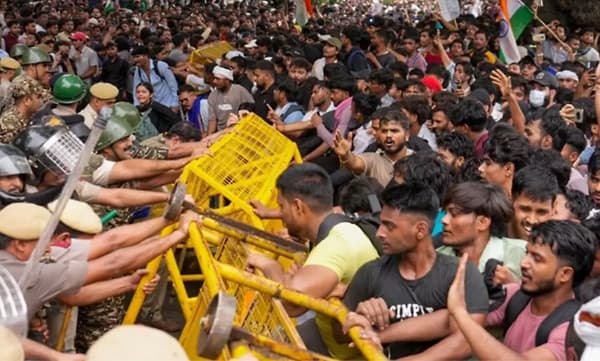
Instead of being channeled into Science, startups, and civic innovation, a significant portion of youth energy is consumed by caste, religious, and sectarian mobilizations. Thereby a significant portion of youth energy is diverted toward religious, caste-based, and sectarian mobilizations instead of science, technology, entrepreneurship, and civic engagement. A nation’s greatest asset, its young minds, is being misdirected. The recent protest initiated and led by CJP against the Union government for question paper leak is a reflection of the resentment of Indian youth against the divisive and communal attitude of the the ruling forces in power.
4. Politics of Division Over Unity
Communal polarization weakens the social fabric. When public discourse revolves around identity rather than development, trust erodes and resources are diverted from healthcare, education, and infrastructure to managing conflict. Communal Polarization and Lack of Social Harmony adversely affect the development of the country. Efforts to divide society along lines of caste and religion undermine national integration. Communal politics weakens trust and diverts public resources from development.
5. Campuses Losing Their Autonomy
Vice-Chancellors and academic leaders are too often chosen for communal ideological alignment rather than academic credentials. Appointments of Vice-Chancellors and institutional heads based on ideological or communal affiliations rather than academic excellence have, no doubt, eroded autonomy and research quality in higher education. This politicization has damaged institutional autonomy and the quality of research in our universities. It is a dangerous and damaging act to glorify mythology as Science and History. Politicization of Academic Leadership should be strongly opposed and condemned.
6. Innovation Starved by Bureaucracy
India has the talent for research, development of innovative ideas and startups, but lacks the ecosystem to scale it. Bureaucratic delays and weak incentives mean that brilliant ideas often die before they reach the market.
7. Secularism Under Strain
When public institutions apply rules inconsistently, citizens perceive bias, and even the secular and democratic principles laid down in the constitution are being questioned and challenged. Equal opportunity becomes a promise on paper, not a reality in practice. This corrodes governance and public faith. We should not forget the broad and secular minds of the Europeans and Americans where many non-Christians become their national political bureaucrats. The British prime minister was once an Indian Hindu who was wholeheartedly accepted by the Christian country. Erosion of Secular Principles in Public Life will lead to the rejection of India in the civilized world. Inconsistent application of secularism in public institutions creates perceptions of bias and unequal opportunity, affecting governance and social trust.
8. Unemployment and Talent Migration
High-skill job creation has not kept pace with our graduates. The result is a brain drain; our best minds building other nations while India loses critical human capital. Insufficient job creation in high-skill sectors pushes educated youth to seek opportunities abroad. This “brain drain” depletes India’s human capital.
Immediate Solution:
All academic and administrative heads should be secular and academic scholars, make them absolutely free from communal and religious considerations. Besides, the political bureaucracy should take urgent measures to:
1. Reform Curriculum: Shift from rote to competency-based, skill-oriented education with industry linkage.
2. Immediate Recruitment: Fill all teaching vacancies with transparent, merit-based processes.
3. Depoliticize Institutions: Ensure academic leadership is appointed solely on academic and scientific credentials.
4. Promote Scientific Temper: Integrate constitutional values, scientific reasoning, and civic education in schools.
5. Inclusive Policies: Enforce secularism and equal opportunity in all public sector institutions, and channel youth toward innovation, startups, and national service programs.
6. Depoliticize Academia: Appoint Vice-Chancellors and institutional heads only on academic and scientific merit through peer-reviewed selection.
7. Instill Scientific Temper: Teach constitutional and secular values and their importance for national development and global acceptance of India in the world,scientific reasoning, and civic responsibility in every educational institution.
8. Uphold Equal Opportunity: Enforce secularism and a strict code of conduct in all public institutions. Conduct diversity audits.
9. Engage the Youth: Create national programs that direct youth toward innovation, entrepreneurship, research, and service.
10. Promote and strengthen Industry-Institute tie ups: Give tax benefits for research, set up incubation centers in every university, and support MSMEs through Skill India Digital Hub.
It must be the responsibility of all administrators and political rulers to ensure that the ultimate aim of the Government and political parties shall be based on the slogan, “ Invest in Minds, Not Divisions”
In a nutshell, India’s development trajectory depends on its ability to prioritize merit over identity, science over superstition, and unity over division. By addressing educational gaps, ensuring quality leadership, promoting industry and innovation, and upholding constitutional values, India can unlock the full potential of its youth and resources. The solutions lie not in rhetoric, but in consistent policy implementation and collective national will.
A nation cannot become great by dividing its people. India’s future depends on one simple choice: *merit over identity, science over superstition, unity over division.
If we fix education, create jobs, depoliticize institutions, and uphold constitutional values, we will unlock the potential of 1.4 billion people. The Government should address each and every question being raised by the people of our country. The strength of the country is the unity and harmonious existence of all religions in India: Hindus, Muslims, Christians, Sikhs etc.
The answer is not more speeches. The answer is implementation.
When we invest in minds instead of dividing them, and in industries instead of identities, India will claim its rightful place as a developed nation. The government should be keen to propose actionable pathways to transform challenges into opportunities for a prosperous, equitable India based on Democracy and Secularism.






Comments