


The right of a citizen to cast his vote is not a mere procedural formality conferred by statute; it is
the most significant cornerstone of democracy, the fundamental sacrament of a Republic. In the
grand edifice of constitutionalism, if liberty is the arch and equality the pillar, then suffrage is the
very foundation upon which both rest. The Constitution of India, in its profound wisdom,
enshrines universal adult suffrage under Article 326 not as a privilege to be dispensed by the
State, but as an inviolable attribute of citizenship itself. Any denial, abridgement, or manipulation
of this right is therefore not an administrative lapse; it is a direct and egregious infringement of
the fundamental rights guaranteed under Part III of the Constitution, and an assault on the basic
structure itself.
It is in this grave constitutional context that the present state of the Election Commission of India
must be examined. The Commission was envisaged by the framers as an institution of
unimpeachable integrity, an autonomous and insulated sentinel that would hold the scales even
between the mighty and the marginal. The Chief Election Commissioner was meant to be a
personification of impartiality, a constitutional functionary whose very presence would inspire
public confidence.
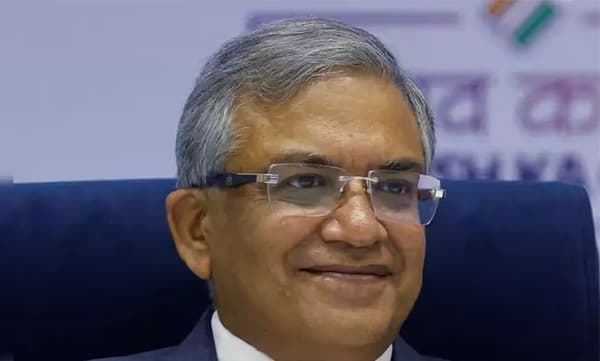
Regrettably, under Chief Election Commissioner Gyanesh Kumar, this institution has witnessed
an unprecedented erosion of credibility. His actions and decisions have been patently illegal,
ethically unconscionable, and constitutionally perverse. Far from acting as an impartial arbiter,
the Commission under his stewardship has conducted itself in a manner that is partisan,
opaque, and utterly horrifying to the democratic conscience. The deliberate inaction in the face
of blatant violations, the selective application of the Model Code of Conduct, and the brazen
disregard for the principle of a level playing field constitute a betrayal of the constitutional oath.
A constitutional functionary who loses the confidence of the people has no moral or
constitutional right to continue. Mr. Gyanesh Kumar has lost his credibility beyond redemption.
Indian democracy has lost its belief in him. When the guardian of the ballot becomes an
instrument for its subversion, his continuance in office becomes an anachronism and an affront.
Resignation, in such circumstances, is not merely a political demand; it is the minimum
atonement that constitutional propriety demands.
This collapse of institutional credibility cannot be divorced from the bureaucratic antecedents of
the incumbent. Mr. Gyanesh Kumar's service history, particularly his tenure in Kerala, is replete
with controversies that raise serious questions about probity and administrative ethics. It is a
matter that has been widely discussed and reported in the public domain that his name was
mentioned in connection with the tragic and deeply disturbing incident of a Malaysian civil
engineer and chief project manager for the PATI-BEL consortium, Lee See Been who
committed suicide in 2006 during a World Bank-funded Kerala State Transport Project (KSTP)
upgrade of the Main Central (MC) Road in Kerala, India. His suicide note mentioned Gyanesh
Kumar who was then the Kerala Public Works Department (PWD) Secretary and is currently the
Chief Election Commissioner of India, alleging bribe demands, harassment, and stalled
payments. Now, in October 2026, the Kerala Home Department ordered a fresh Vigilance and
Anti-Corruption Bureau (VACB) investigation into the 2006 case and allegations that the original
inquiry was influenced or derailed.
While the full facts of that dark episode remain a subject of public debate, the mere association
of a senior bureaucrat's name with such a sordid controversy is a clear indication of a tainted
and corrupt background. Such a past is fundamentally incompatible with the exacting standards
of absolute integrity required for the office of the Chief Election Commissioner. To entrust the
destiny of more than 140 crore Indians to a person with such a checkered and controversial
legacy is to imperil democracy itself.
The most damning indictment of the present regime, however, lies in the figures that have now
emerged from the electoral field. It is reported that a staggering 13 crores of citizens have been
disenfranchised and ousted from the electoral rolls. Even if one were to go by the more
conservative figure of 13 crores, the magnitude of this act is cataclysmic. To strip 13 crore
Indians of their right to vote is not an administrative error. It is not a clerical oversight. It is an
inexcusable, calculated, and criminal offence against Indian Democracy and the Constitution.
To delete the name of one voter without due process is a travesty of justice; to delete thirteen
crores is the systematic annihilation of Democracy. It is electoral cleansing on an industrial
scale. It amounts to stealing the Republic itself. The right to vote is not given by the Election
Commission; it is taken away by it, and when it is taken away on such a colossal scale, it
constitutes a fraud upon the Constitution and a conspiracy against the people.
For such an offence, mere resignation is insufficient. The Constitution of India, under Article
324(5), provides for the removal of the Chief Election Commissioner in like manner and on like
grounds as a Judge of the Supreme Court. That is, through impeachment by Parliament. This is
precisely the constitutional remedy that must be invoked. Gyanesh Kumar must be impeached
by the Indian Parliament for this monumental crime of mass disenfranchisement. Parliament, as
the custodian of the people's Will, cannot remain a mute spectator when the very source of its
own legitimacy, the electoral roll, is being mutilated. To fail to impeach would be to become
complicit in the crime.
No political party and no government, however powerful, can perpetuate its hegemony through
political corruption and the stealing of votes. History bears eloquent testimony to the fact that
empires built on electoral fraud are ephemeral. They may survive for a season through
manipulation and intimidation, but they inevitably collapse under the weight of their own
illegitimacy. The Indian voter is forgiving, but he is not forgetful. He may be silent, but his silence
is not consent.
The right to vote is the soul of Indian Democracy. It is the voice of the voiceless, the power of
the powerless. It is what makes a daily wage laborer equal to a billionaire inside the polling
booth. To protect this soul, to preserve this sanctity, extraordinary measures have become
imperative.
The protection of this soul demands two inseparable actions: (i) the ouster of a compromised
Chief Election Commissioner through the constitutionally mandated process of impeachment,
and (ii) the ouster from power of the Bharatiya Janata Party, which is the political beneficiary of
this entire architecture of electoral subversion. The two are symbiotic: one cannot survive
without the other. To save Indian Democracy, the fountainhead of electoral manipulation must be
dismantled and the political edifice that sustains it must be dislodged by the people through their
remaining democratic power.
If the Judiciary, the only refuge for the protection of a layman's rights and the only guardian of
justice, keeps mum and winks at this monumental injustice and denial of fundamental rights, it is
quite natural that the people will lose their faith in the Judiciary as well. Therefore, the time for
equivocation is over. The time for action is now.
-ADV. ABRAHAM CHETTISSERY







Comments