


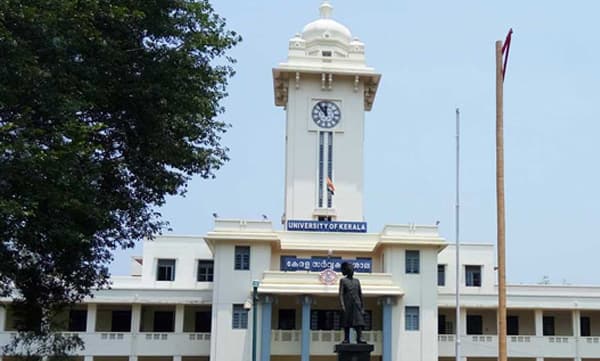
Why Kerala University Wants to Ban or restrict Campus Politics - And how Campus Politics
Makes Good Citizens and Future Rulers. It should be subject to a socio-political analysis.
Kerala University's new move to restrict and ban campus politics is not an innocent
administrative reform. It is a calculated agenda to kill the soul of Kerala's education.
For years, there has been an attempt by certain forces to depoliticize campuses. The Vice-
Chancellor's recent circulars, disciplinary actions against student organizers, banning of political
posters, banning of strikes and dharna inside campus, and the proposal to replace elected
student unions with nominated councils - all are part of one agenda: To make the campus free
from politics so that the campus can be made free from questions. The ruling class is always
afraid of the younger generation, intelligent human brain and intellectuals created by and from
our university campuses.
But those who want to ban campus politics forget one truth - a campus without politics cannot
make a citizen, and a nation without citizens cannot make a democracy.
What is Kerala University's Agenda?
1. To Create Apolitical, Obedient Graduates:
The university administration wants students who only study, write exams, and leave. They don't
want students who ask why fees are hiked, why guest lecturers are not paid, why hostel food is
bad, why there is no reservation in appointments. Campus politics is the only tool that makes
administration accountable. Banning it means the administration becomes a dictatorship.
2. To Help the Communal and Drug Mafia Take Over:
This is the biggest danger. When democratic, open, ideological student politics of SFI, AISF,
KSU, MSF, AISA is banned, politics does not disappear. It goes underground.
Kerala's campuses have seen it - when open politics is banned, secret communal groups,
religious fundamentalists, and drug rackets enter. Open politics fights communalism openly.
Banned politics allows communalism to work secretly. Kerala University is opening the door for
the very evils it claims to be stopping.
3. To Destroy Kerala's Democratic Model:
Why is Kerala different from Bihar, UP or Gujarat?
Because Kerala has had 70 years of uninterrupted campus politics. The land reforms, the
literacy movement, the public health system, the secular fabric - all were built by leaders who
came from campuses.
Kerala University is trying to cut the root of Kerala model. They want to convert our universities
into private coaching centers where politics is a crime and obedience is a virtue.
4. The Values of Campus Politics in Molding Good Citizens
A classroom makes a clerk. Only a campus makes a citizen. What are the values that campus
politics teaches that no textbook can teach?
a) The Value of Constitution and Secularism: In campus politics, a student learns that a Dalit
student, a Muslim student, a Christian student and a Hindu student all have equal right to
contest and vote. He learns to live with difference. This is secularism in practice, not in theory.
b) The Value of Courage: When a student stands for a fellow student who was denied hostel
admission due to caste, he learns courage. When he questions a powerful principal, he learns
that power is not permanent.
c) The Value of Empathy and Social Justice: Campus politics fills the lapse and loss of social
values. When society outside becomes selfish, campuses discuss poverty, gender justice,
environment, and human rights. The student who fights for a fee concession for a poor student
becomes a citizen who will fight for justice tomorrow.
d) The Value of Debate and Dissent: In a union debate, a student learns to argue without
hating, to oppose without abusing. This is the core of democracy. A student who has debated in
college will never support lynching or hate speech outside.
e) The Value of Leadership and Accountability: A college union chairman has to present
accounts, answer questions, and face re-election. This is the first training in accountability. No
management class can teach it.
Thus, campus politics does not make a student a politician; it makes him a good human being, a
good citizen who knows his rights and his duties.
5. The Values of Campus Politics in Molding Future Rulers
Where does India get its future rulers? Not from IAS academies, but from campuses.
Look at the history of the world and India: The Chinese Cultural Revolution, despite its
complexities, proved that students can shake a corrupt bureaucracy and demand that power
must serve the people.
In America, it was campus politics at Berkeley, Columbia and Kent State that stopped the
Vietnamese war. Students who were shot dead for protesting created a new America. Many of
those student leaders later became Senators, Congressmen, and professors who shaped
American democracy.
In India's Independence Struggle, freedom came from college verandahs. Bhagat Singh,
Subhash Chandra Bose, Nehru, Lohia, Jayaprakash Narayan, many of the Communist and
Socialist leaders - all were products of campus politics. Mahatma Gandhi himself called upon
students to boycott British colleges.
In Kerala, every great Chief Minister - from E.M.S to A.K.Antony to Oommen Chandy to Pinarayi
Vijayan - was once a campus leader. The best writers, the best journalists, the best lawyers, the
best teachers in Kerala are all products of campus politics.
If you ban campus politics today, where will Kerala get its rulers tomorrow? You will get rulers
from WhatsApp forwards and from money power, not from struggle and sacrifice.
A future ruler must know how to listen, how to lose, how to compromise, how to lead a crowd,
how to face defeat. Where will he learn this? Only in campus elections. A student who has lost a
college election learns more about democracy than a man who has won a Lok Sabha election
by buying votes.
6. For Democracy and Rule of Law To Be Perfect, Campus Politics Is Inevitable
After all, what is democracy? Democracy is not just a vote once in five years. Democracy is
daily practice. And where is that daily practice learned? In the campus.
Rule of law does not mean police and courts. Rule of law means a citizen who knows the law
and demands its implementation. That consciousness comes only when a student fights against
an unfair rule in his own college - against fee hike, against caste discrimination in hostel, against
sexual harassment.
If you ban politics in campus to ensure law and order, you are killing law in order to save order.
A campus without politics is like a Parliament without opposition. It may look peaceful, but it is
dead. Real peace comes from debate, not from silence. Real rule of law comes when students
are allowed to question the rules and make better rules.
Therefore, for democracy to be perfect, for rule of law to be living, campus politics is not an
option - it is inevitable, and moreover, it is oxygen.
The History Proves That Banning Will Fail
Can you ban politics from life? History says “No”.
The Chinese Cultural Revolution showed that when bureaucracy became corrupt, students rose
to question the headquarters. The American students stopped the Vietnam War when the
government wanted to continue it. The Indian Independence came because students left their
colleges on Gandhiji's call. Kerala became Kerala because its campuses were political.
You can ban an organization, but you cannot ban an idea or ideology. You can remove a poster,
but you cannot remove a thought.
In a nutshell, no bureaucrat or a ruler can Kill the Future. Kerala University must understand - its
agenda to restrict and ban campus politics will have only one result: it will create a generation of
politically illiterate, socially insensitive, and democratically dead graduates. It will destroy the
factory that makes good citizens and future rulers.
The future of India is not made in the Vice-Chancellor's office. It is made in the college union
election, in the canteen debate, in the strike for a poor student's admission.
If you close the union room, politics will go to the canteen. If you close the canteen, it will go to
the classroom. If you close the classroom, it will come to the streets of Kerala.
Those who want to ban campus politics are those who are afraid of students asking questions.
And a university that is afraid of its own students has lost the right to call itself a university. A
nation that is afraid of its campuses has lost the right to call itself a Democracy.
(*VOX DISCIPULORUM, VOX DEMOCRITIAE is a Latin Term which
means 'Voice of Students, voice of Democracy')
- Abraham Chettissery



Comments